




Recent Post

04 November 2026
What to Pack in Hospital Bag for Mom in 2026

03 October 2026
27 Best Baby Shower Gifts for First-Time Moms (2026)
What to Pack in Hospital Bag for Mom in 2026
You've opened a suitcase on the bed, set aside baby's going-home outfit, and realized your own things are still scattered between the bathroom and the laundry basket. It's easy to prepare for the baby and leave your recovery until last.
If you're deciding what to pack in hospital bag for mom, start with comfortable recovery clothes, underwear and maternity pads, toiletries, prescription medicines, documents, and your phone and charger. Organize them into a labor pouch, a bedside pouch, a discharge outfit, and a home recovery station. At SwagglyLife, we start with what you'll reach for when you're tired, sore, or holding your baby, then consider the small comforts that make those moments gentler.
Table of Contents
- What a Mom's Hospital Bag Covers
- The Pouch Checklist With Real Quantities
- When to Pack Each Piece
- Cesarean, Induction, and a Longer Stay
- Questions Moms Ask Before Packing
- Comfort to Pack, What to Leave, and the Handoff Home
What a Mom's Hospital Bag Covers
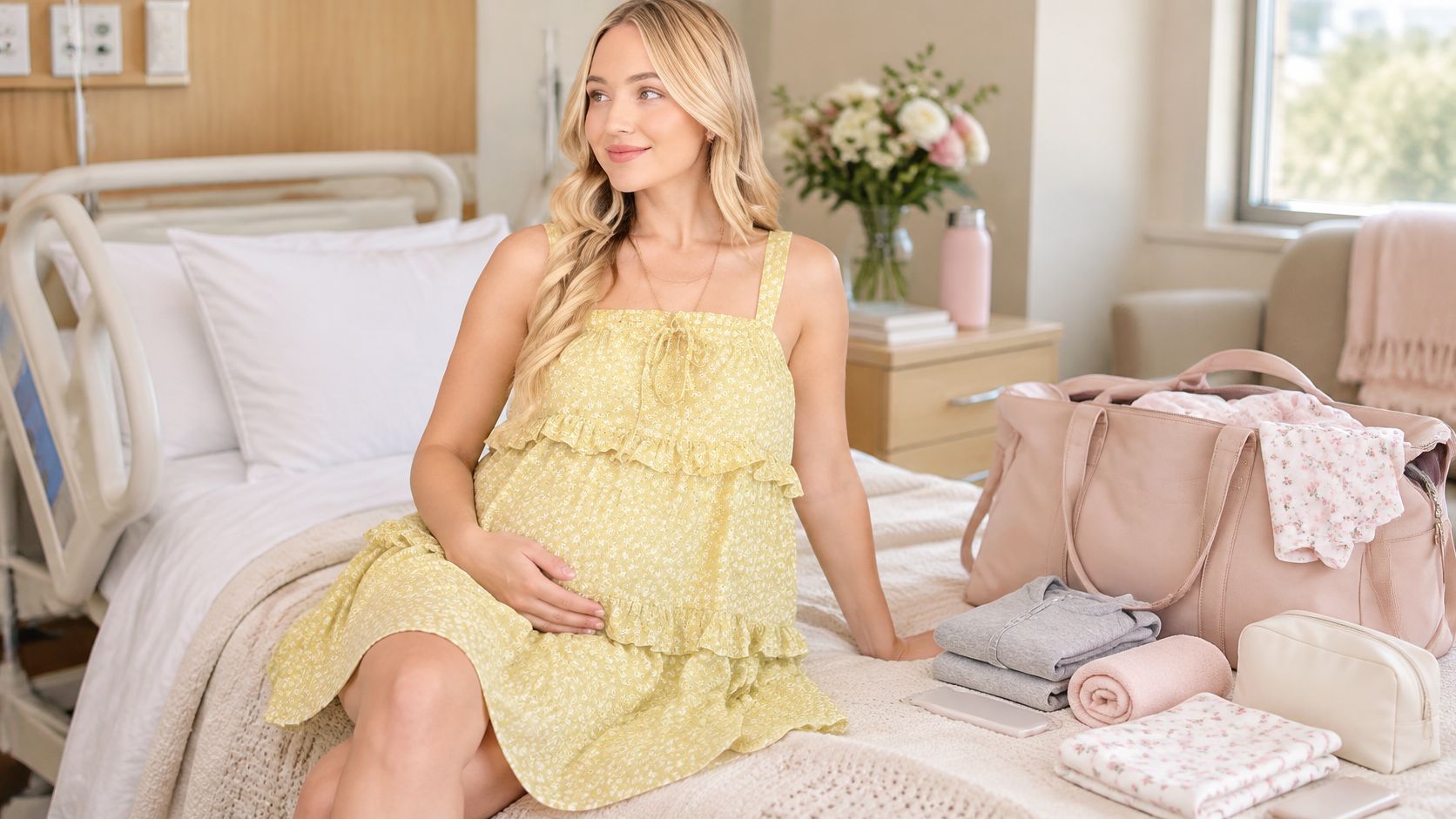
You arrive as contractions become harder to talk through. Your support person needs the paperwork, and you want your lip balm without opening the whole suitcase. A small labor pouch keeps those first-reach items together, while the rest of the bag stays packed for later.
Put photo identification, your insurance card, birth preferences, and a medication list in one folder. Add prescription medicines in their original containers, your phone and a long charging cable, glasses, hair ties, and nonslip socks. Keep medicines accessible, then tell staff what you brought rather than taking them on your own during admission.
Plan around recovery and care
The World Health Organization recommends that healthy mothers and newborns stay in a health facility for at least 24 hours after an uncomplicated vaginal birth, with routine maternal assessments starting in the first hour. Staff check bleeding, uterine contraction, fundal height, temperature, and pulse. Clothing that gives staff access to check these areas can make assessments easier while helping you feel covered.
Planning floor: Prepare for an overnight recovery, not a promised discharge time. Your care team will decide when you and your baby are ready to leave.
Hospital supplies vary by unit. Ask at pre-registration whether your unit provides gowns, mesh underwear, large pads, and newborn diapers. That answer helps you decide whether to bring preferred alternatives or rely on what is available. The pouch checklist gives clothing and bathroom supplies their own place, so this section can stay focused on what you need within reach during admission.
Your discharge outfit should be easy to put on, with shoes that do not need tying. Choose loose, comfortable clothing that accommodates postpartum pads and feels comfortable against your body.
The Pouch Checklist With Real Quantities
Mom hospital bag by pouch
| Pouch | Pack | How many | Why it is here |
|---|---|---|---|
| Labor pouch | Photo ID, insurance card, birth preferences, medication list | 1 folder | Intake shouldn't require opening the suitcase |
| Labor pouch | Phone and charging cable long enough for a far outlet | 1 phone and cable | Bedside outlets may be out of reach |
| Labor pouch | Glasses, lip balm, hair ties | 1 set | Glasses offer a comfortable alternative when contacts feel dry |
| Labor pouch | Nonslip socks | 1–2 pairs | Grip helps on smooth floors; choose a nonbinding fit |
| Bedside | Front-opening sleep set or robe plus a spare top | 2–3 clothing changes | Skin-to-skin and feeding without an overhead change |
| Bedside | Soft non-underwire bras | 2–3 | Still useful if feeding plans change |
| Bedside | High-waist underwear or disposables | 5–6 pairs | Room for pads, with a waistband positioned away from a possible incision |
| Bedside | Maternity pads | 2 packs | A personal reserve if your unit doesn't provide your preferred supplies |
| Bathroom | Toiletries and shower sandals with grip | 1 kit | Familiar basics and traction for showering |
| Baby pouch | Easy-open outfits, hat, light blanket, going-home set | 3–5 outfits, including the going-home set | A wet or soiled outfit needs a replacement |
| Discharge | Slip-on shoes and loose pad-friendly pants or gown | 1 outfit | No bending to tie shoes |
These are packing allowances, not a requirement to use everything. If your hospital confirms that it provides pads throughout your stay, leave the unopened reserve with your home supplies rather than squeezing it into an already full bag.
Give every pouch a job
The labor pouch should open without disturbing anything else. Put paperwork in a flat sleeve and small essentials in a zippered compartment, rather than letting your glasses case and lip balm disappear beneath clothing.
For bedside clothing, count complete changes rather than individual garments. A front-opening top with loose pants is a change; a nightgown is another. You don't need multiple matching sets plus separate daytime outfits.
Choose underwear you won't mind staining. High-waist doesn't automatically mean incision-friendly: the elastic should sit comfortably away from the affected area, without rolling, rubbing, or pressing.
Keep the bathroom kit washable and simple:
- Daily basics: Toothbrush, toothpaste, deodorant, face wash, moisturizer, and a brush or comb.
- Shower supplies: Small bottles of your usual products and sandals with a textured sole.
- Used clothing: A laundry bag to separate damp or stained garments from clean ones.
A hanging toiletry bag can help when counter space is limited. Avoid packing new fragranced products just because they came in a gift set; familiar products are easier to assess if your skin feels sensitive.
Separate baby's layers from your recovery clothes
Fold each baby outfit together so a caregiver can retrieve it without sorting tiny pieces. Keep the going-home set clearly marked, but don't make it so precious that it can't become the backup outfit.
Ask your unit specifically about diapers, wipes, blankets, and baby clothing. A hospital that provides diapers may have a different policy for wipes or take-home supplies.
Finish with a placement test: ask your support person to find your paperwork, clean underwear, and baby's next outfit without your help. If they need you to narrate every zipper, simplify the layout.
When to Pack Each Piece
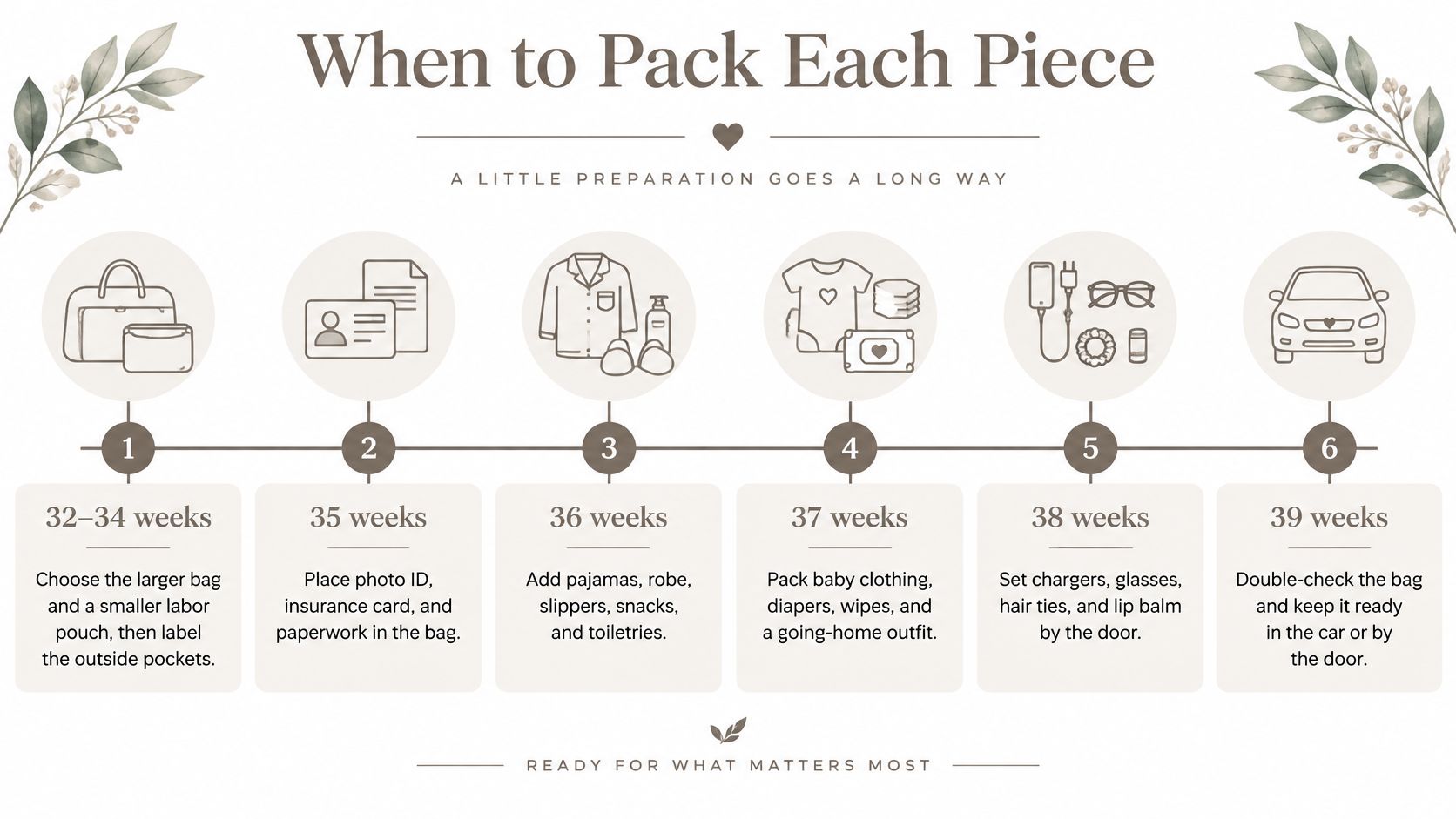
At 32 weeks, the bag can still feel like a distant task; by the time you need it, small decisions can be harder to make. Use this calendar as a household schedule your care team can adjust. The goal is to finish most packing before your due week and leave only daily-use items to add on departure day.
Make the decisions before admission
- Around 32–34 weeks, choose your bags. Use a larger bag you already own and a smaller pouch that's easy to carry. Label the outside pockets with clear descriptions, such as documents or medicines.
- By 35 weeks, organize admission paperwork. Put birth preferences and insurance information in an outer pocket. If you use your original photo ID every day, leave it where it belongs and put a reminder on the bag for departure.
- By 36–37 weeks, finish clothing and bathroom supplies. Pack the baby pouch and pad reserve, then avoid swapping outfits unless your needs change. The Texas Children's hospital bag checklist recommends having the bag ready around this stage, with earlier preparation when your care team identifies preterm or induction risk.
- During the final week of preparation, plan for everyday items. Keep prescription medicines in their original labeled containers and maintain an up-to-date medication list. Attach a reminder for medicines, glasses, and your charging cable to the bag handle. Your packed bag should never require you to interrupt prescribed treatment.
- Pack water and snacks with their purpose in mind. Ask your care team about eating and drinking during labor, especially if your care plan changes. Keep snacks intended for labor separate from snacks for postpartum recovery; if eating during labor isn't appropriate for you, reserve those snacks for after birth or for your support person.
If you're considering Mama and Baby essentials at SwagglyLife, use the labor pouch's remaining gaps as a shopping list. Fill only what's missing, rather than packing a second version of something you already own.
Leave room for the non-packing preparation
Packing during your due week leaves little margin if admission comes sooner than expected. Preparing earlier works well too; revisit clothing fit and any changes to your feeding or birth preferences as the date approaches.
If practical tasks are crowding your thoughts, a short pregnancy journaling routine can give those concerns a separate place. For postpartum bathroom preparation, read our Perineal Care After Birth: The New Mom's Gentle Recovery guide. It covers gentle cleansing, comfort measures, and signs that may warrant a conversation with your healthcare provider. Use your maternity team's instructions to guide your individual recovery.
Choose a discharge outfit that feels comfortable and practical for your recovery. Loose-fitting clothing, a soft nightgown, or relaxed pants with a comfortable top can make getting dressed easier. Consider whether you will need front access for feeding or whether a waistband might feel uncomfortable.
Keep the labor pouch within reach during the trip. The larger bag can wait until you're settled.
Cesarean, Induction, and a Longer Stay
If birth takes longer or recovery calls for a few extra days, the right clothes should stay easy to reach without crowding the labor pouch. The American College of Obstetricians and Gynecologists' cesarean birth guide describes a usual hospital stay after cesarean birth as 2 to 4 days. Pack for the route you're most likely to need, then keep a small reserve for the others.
How the bag flexes by birth path
| Path | Plan the stay for | Clothing change | Add only this |
|---|---|---|---|
| Uncomplicated vaginal | At least 24 hours, often 1 night, as a packing floor rather than a discharge promise | Loose, pad-friendly clothing with front access | Nothing beyond the master pouches |
| Induction or epidural | Labor time plus at least 1 night as a practical packing allowance | Same recovery set | A warm layer and the long cable |
| Planned or possible cesarean | Usually 2 to 4 days | High-waist clothing or a gown, with no waistband on the incision | One extra top and underwear for each additional day |
| Route still unknown | The longer stay | Soft high-waist clothing and slip-on shoes | The cesarean extras, kept aside unless needed |
For a one-night stay, pack the clothing in your main checklist. For a cesarean stay of 2 to 4 days, plan one clean top and one clean pair of underwear per day, including the day you expect to leave. That means adding one to three tops and one to three pairs of underwear beyond the one-night set. Keep them together as a bedside reserve, rather than mixing them into the labor pouch.
Choose clothes by movement and pressure
For cesarean recovery, sit down in the pants you plan to pack. A waistband that feels loose while standing may tighten or fold when you sit, and a drawstring knot can press against the incision.
A soft gown avoids that pressure. If you prefer pants, choose a generous rise and fabric that does not need tugging into place each time you move.
Test the movement, not just the size. Can you sit, lift the fabric for care, and change without balancing on one leg?
Leave structured denim and fitted shapewear at home. Ask staff for help with your first changes if getting dressed feels difficult. Your discharge outfit should be something you can manage comfortably, not another task to push through.
Distinguish labor time from recovery time
An induction can involve more waiting, resting, and changing positions before birth. An epidural may change what you can comfortably manage yourself, so keep essentials within reach and follow staff instructions about mobility.
A warm layer is easier to adjust than a succession of outfits, and a charged phone is more useful than extra accessories. In the recovery area, place the bedside pouch where you can reach it without searching through the larger bag.
Feeding plans can change, so a supportive non-underwire bra and easy-access clothing are practical choices. A hands-free pumping bra is a specialized extra. Bring a personal pump only if you plan to use it and your hospital advises bringing it. Confirm which clean or sanitized parts you'll need, whether the unit has equipment available, and how staff can help you use it.
If the birth route is uncertain, use the longer-stay clothing plan. Compress the reserve together and leave it unused if you go home sooner.
Questions Moms Ask Before Packing
Does my partner need a separate bag?
Not necessarily for a brief visit, but someone staying overnight should pack their own clothing, toiletries, and any bedding the unit recommends. Their main job with your bag is to manage the labor pouch at intake and retrieve supplies without making you direct every search.
Should I bring diapers and wipes?
Many U.S. hospitals supply them, but don't assume that diapers, wipes, and blankets all follow the same policy. Ask during pre-registration or your maternity tour, then pack what the unit confirms it doesn't provide.
Do I need a car seat for discharge?
Yes, if your baby will travel by car, arrange an appropriate rear-facing car seat and learn how to use it before admission. Confirm the hospital's discharge process, follow the seat and vehicle manuals, and don't assume staff will install it for you.
What if I'm discharged much sooner than expected?
Keep the labor pouch and discharge outfit accessible even when you anticipate a longer stay. Before leaving, make sure you understand your follow-up appointments, feeding plan, warning signs, and whom to call; a packed bag doesn't replace a clear discharge conversation.
Who should answer questions about medicines, bleeding, or incision care?
Your OB-GYN, midwife, or maternity team should guide your recovery and medication questions; your baby's pediatrician should guide newborn concerns. SwagglyLife's pregnancy leg cramp comfort guide can support general preparation, but new postpartum leg pain, especially with swelling, redness, chest pain, or breathing difficulty, needs prompt medical assessment rather than a comfort remedy.
Comfort to Pack, What to Leave, and the Handoff Home
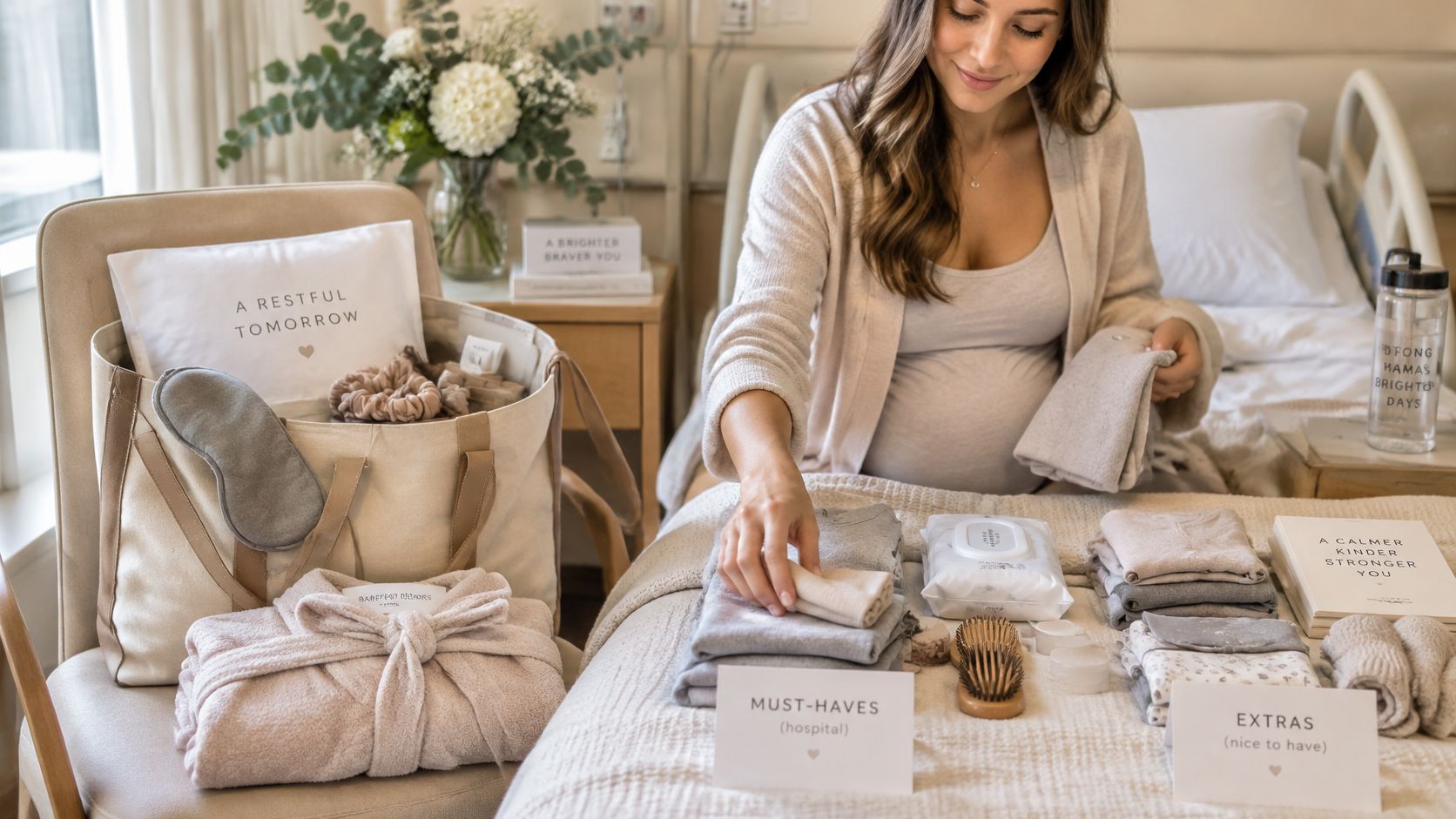
Choose comfort items that make rest or everyday tasks easier: a clean pillowcase, eye mask, lip balm, hair ties, or a robe you will wear. A few familiar things can make an unfamiliar room feel more manageable. Keep the bedside surface clear enough for water, your phone, and supplies staff may need within reach.
Let comfort earn its space
Before closing your bag, ask whether each item helps you rest or makes care easier:
- Keep what helps you rest: An eye mask or familiar pillowcase may be more useful than another outfit.
- Leave what needs managing: Jewelry, a full cosmetics bag, stiff clothing, and delicate accessories mean more to protect, clean, or locate.
- Skip room fragrance: Leave candles at home and be considerate of scent in a shared care environment.
- Check before packing treatments: Discuss wound products or other treatments with your care team rather than bringing supplies for staff to use without asking.
A soft robe can be a comforting layer during your hospital stay and a favorite to reach for again at home. Look for a relaxed fit that feels gentle against your skin and is easy to remove when needed. SwagglyLife’s Saranoni Minky Stretch Luxe Robes offer a cozy option for those quiet moments of rest and recovery. Explore the Saranoni Minky Stretch Luxe Robes.
Prepare the place where you'll actually recover
Discharge timing varies with your birth and your care team's assessment. The Merck Manual's postpartum care overview describes discharge after uncomplicated birth within 24–48 hours, and in some circumstances as early as six hours. Follow your own team's instructions.
Set up one home station before admission so the first bathroom trip or rest at home takes less effort. Put pads and clean underwear in the bathroom. Near your resting place, keep water, high-fiber snacks, your charger, and supportive pillows together. Place supplies within comfortable reach, rather than low down or overhead. If you have stairs, decide where you are most likely to rest and ask your team about movement restrictions.
SwagglyLife's perineal care after birth guide can help you prepare practical bathroom questions. Use a peri bottle, cold packs, or wound-care products according to your discharge instructions, not because they appear in a product list.
The useful luxury is often access: a clean change within reach, water already poured, and someone else handling the bags.
Make the handoff simple
Use one clear script for the trip home: “Documents are in the outer pocket, baby layers are in the labeled pouch, and discharge shoes are on top.” Then let your support person carry the luggage and keep walkways clear, so you can focus on moving safely and getting settled. Ask someone at home to prepare your resting place before you arrive.
SwagglyLife brings together motherhood essentials, baby care, personal comforts, and home accents from selected brands. If you still need something for your recovery space or a keepsake for later, browse SwagglyLife's collections with those needs in mind. Keep practical recovery supplies first; choose a beautiful extra only if it has a real place in your plan.


